Math
Hello Families,
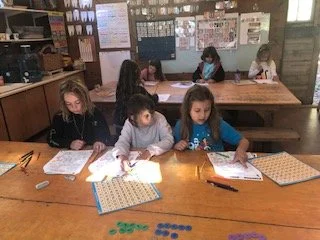
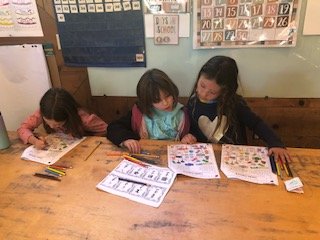
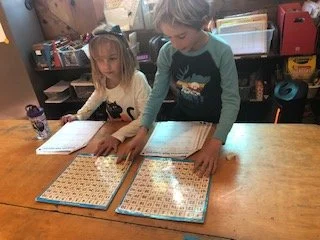
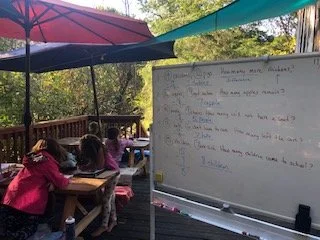
Over the course of the month of November, students continued to practice a multitude of math strands and concepts. Skills included adding and subtracting, developing fluency in single digits, and computational skills with double digits. They were offered a variety of manipulatives to help them, and most have moved from concrete objects such as blocks to the number lines and number grids. Many are adding and subtracting 10s and 1s on the number grid and some have been practicing double digit computations by first addressing the ones, then tens place using a standard model. They are learning a variety of strategies for addition including those above and counting up (on fingers, number lines, number grids), drawing or using base ten blocks or disks to see the problem and group the tens and ones then counting them. To help develop addition and subtraction fluency I highly recommend “Fact Family” cards. I added a link below for my favorite set because they include a visual aid with them. They would make a great gift!
Second graders are working on reading mathematical word problems and determining which operational sign to use to calculate the problem, and to include the subject (unit) in the answer. This is helping them learn to reason, problem solve and word problems teach mathematical vocabulary as they use real life math problems and develop mathematical literacy.
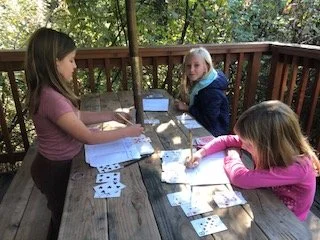
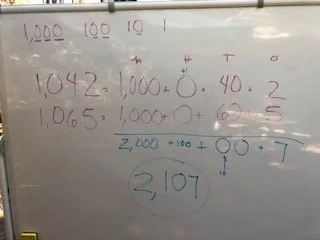
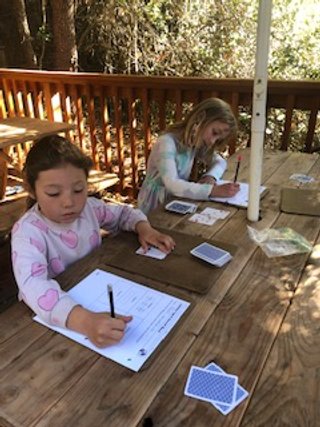
Students were given a lesson on “Expanded Notation” and place values. Expanded notation, also called expanded form, is a handy way to write numbers that shows the place value of each digit. It looks like an addition problem and will help you break numbers down and understand their place value. They practiced creating numbers into the thousands by pulling cards. For example, the cards 5, 8, 6, and 7 are arranged from largest to smallest and given a place value, so 8,765 becomes 8,000 + 700 + 60 + 5. Students also practiced comparing 3 digit numbers by playing cards. Each student turns over 3 cards and builds the biggest 3 digit number they can then compares it to their opponent's biggest number. Whoever has the biggest amount takes the hand, “Top It”. They also played “Top It” by adding 2 and 3 digits together. This game promotes fluency in addition as they practice adding multiple times.
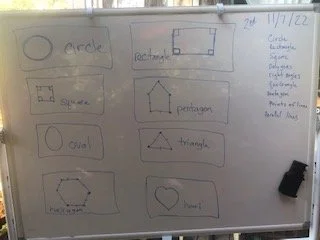
Geometry was also learned and practiced in November. Students learned the difference between polygons and non-polygon shapes, the attributes of triangle, quadrangles, pentagons, hexagons and octagons. They were able to determine the lines, and points in a variety of shapes, and whether they had parallel lines. They also learned how to identify a right angle.
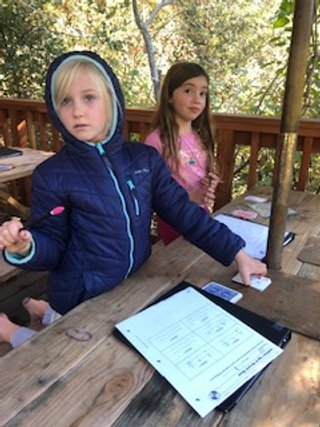
Second graders have enjoyed counting money this month. They are continuing to practice recognizing and counting coins, and have moved on to counting bills. They practiced counting a number of $100.00s, $10.00s and $1.00s. For example, (7) $110s, (6) $10.00s and (3) $1.00s to equal $763.00. They are practicing writing in dollar notation with the dollar sign and decimal points. Today they counted the coins in the Second Harvest Quarter sheet row by row then practiced adding the row amounts in a variety of ways on the calculator. They added 1.5 + 1.5 six times, then they learned the calculator trick of just hitting the = sign to add on the same number, then they learned to use the multiplication sign to a number a number of times. Practicing calculator skills at home is fun and useful.
Finally, the second graders were given a lesson on fractions or ratios. They were counting quarters today so we discussed other “quarters” we might see. The dollar was broken into 4 equal parts, and most had an ah-ha moment about the term quarter. The clock and then lots of food items were also broken into fourths. This lesson gave me an opportunity to revisit ¼ after and ¼ till the hour, and students saw how the hour is broken into 15 minute quarters. We talked about pies and bars and how they resemble a whole, and as we cut them in halves and quarters, we labeled the parts ¼, .25 and 25%. We will be continuing to explore fractions and ratios in the coming weeks.
I hope you all enjoy your Thanksgiving feasts and hope you have some pie your children can help divide. Have them help in the kitchen, and practice math!
-Jenni