Math
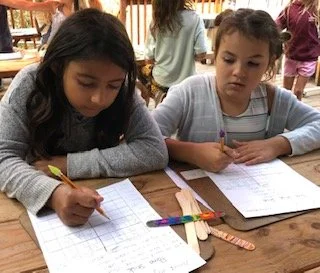
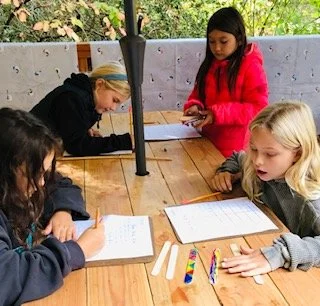
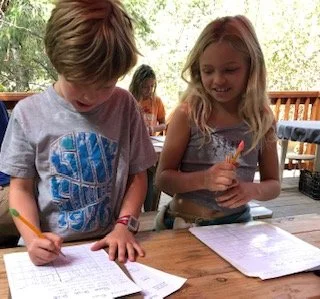
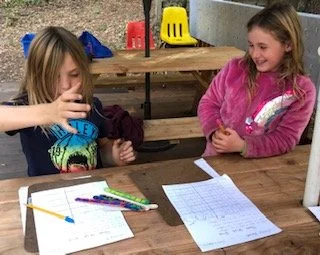
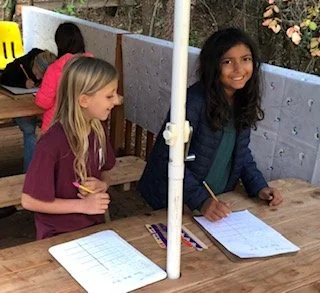
These past few weeks third and fourth graders have been working together as a large mixed group for the most part. Students used multiplication and division strategies in problems stemming from real life questions to promote Mathematical Literacy. Students considered how division and multiplication were related and were introduced to the multiplication/division fact families. EX: 7 x 6 = 42, 6 X 7 = 42, 42 / 6 = 7 and 42 / 7 = 6. One problem solving situation came from the activity of creating a “Pomo Stick Dice” game. Students needed 6 sticks per each pair of students, so they had to calculate how many sticks were needed for 14 students total. The problem was drawn out multiple ways, and shown using several hands-on materials, in order to be seen in a concrete way.
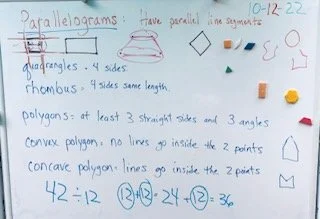
Students have been learning about, reviewing and sharing information regarding geometry. They learned about parallelograms and parallel lines versus perpendicular lines. They explored quadrangles and parallelogram attributes in the square, rectangle, and rhombus, compared to a trapezoid. They named parallelograms and polygons that are two dimensional versus three-dimensional shapes and compared the attributes of 2D vs 3D shapes. Then they used their geometric knowledge and created the sticks needed for the game.
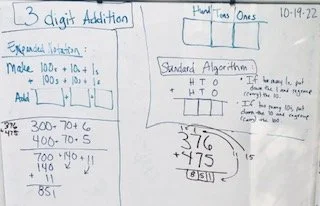
Third and fourth graders continue to practice place value and understanding that only one digit can be in each place value when adding or subtracting whole numbers. They are continuing to practice adding and subtracting with regrouping two digit and three digit numbers and sharing their calculation skills and strategies during “Math Talks”. Most recently students practiced using expanded notation methods for adding three digit numbers, for example, 356+476= 300+50+6 added to 400+70+6, as well as standard algorithm strategies with regrouping. One student shared his unique way of adding a three digit number where he added the ones place in his head then added one of the tens then added the second tens then added the hundreds together, and then put those numbers together, proving that there are multiple ways to see and calculate any problem.
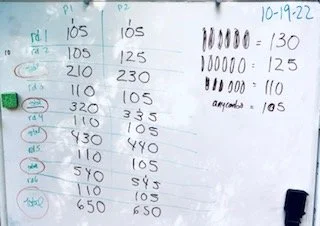
The Pomo Stick Dice game provided continuous opportunities for students to add three digit numbers with regrouping, to practice their skills in a fun, hands-on creative way. They played the game with several different partners to promote friendships and new addition strategies as different students used different strategies to add.
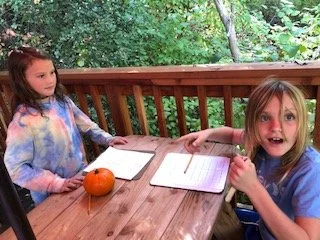
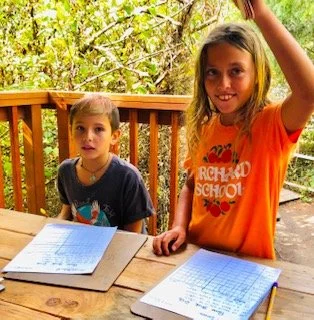
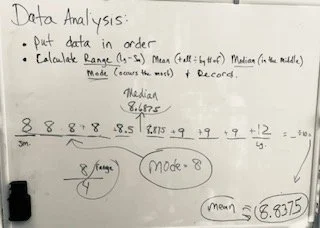
Data from our Apple Exploration week was analyzed using calculations from the circumference, weight, and the amount of juice in ounces they gathered. Students put together the data by writing their actual numbers on their whiteboard then organized themselves in order because the analysis requires ordered numbers. Then, they learn to calculate the range, the median, the mode and the mean of averages. They practiced memorizing, “The range is the rainbow, largest the largest minus the smallest, the Mode occurs the most, the Medians in the middle, where's that at? In the middle. And, the mean is the average, add them up divided by the number of them.” Students who were there each day had the opportunity to practice the skills three times. We will continue to practice these data analyzing skills with our pumpkin investigations next week.
Third and fourth graders are continuing to practice telling time, skip counting, addition, subtraction, multiplication, division, geometry and problem solving skills. They also are working on following directions, focusing and positive communication skills such as tone and volume, choice in words and taking turns to share ideas.
I would encourage all families to play math games, notice opportunities for practicing mathematical problem solving and share when you, as adults, have used math in your daily life. This will help students understand why we learn such concepts. There are several websites that promote understanding and automaticity for addition, subtraction, multiplication and division, as well as grade level concepts. I recommend each student practice mathematics at home regularly, and often, in ways that are useful and enjoyable.