Math
Third and Fourth Grade,
Hard to believe we've only been in school for 3 whole weeks. I’ve been getting to know the campus, the teachers and administrators, the students and many of the parents. Here is what the students have been working on in Math class.
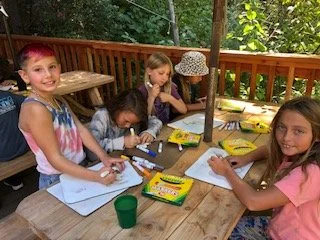
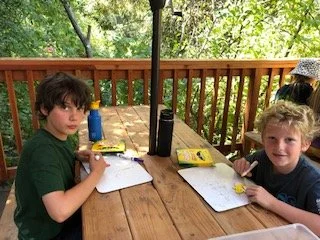
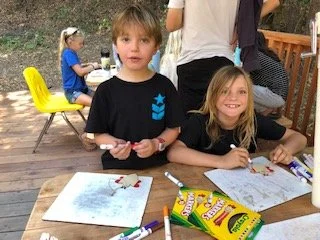
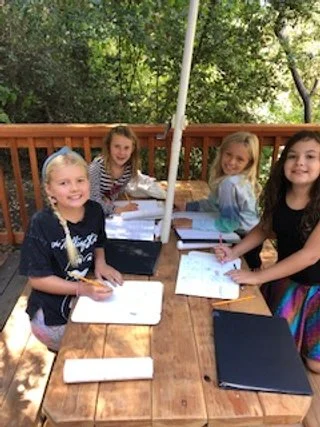
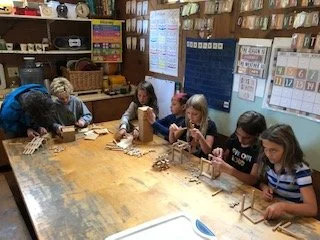
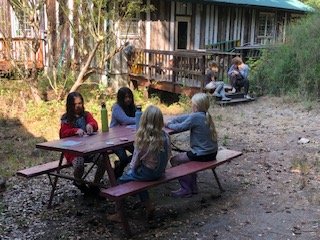
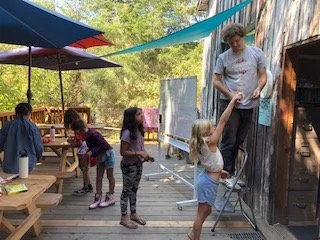
We often begin the class with a whole group math meeting, reviewing concepts that involve addition, subtraction, multiplication, division, fractions, money or time, with a focus on problem solving strategies. These whole group meetings often pertain to current things happening in our world, problems to be solved or something to demonstrate the importance of math and to make math meaningful. For example, we discussed the first day of autumn, and considered why and when the seasons change, and how many months were in each season. I demonstrated a variety of strategies for dividing 12 months by 4 seasons, and included picture drawing, skip counting and number operations. Or, the day begins with a quiet activity to set the tone for the math class period. Students are working on focusing and attending to the subject of math when they come to the Math Cabin. After our whole group time, we may do whole group explorations, games and activities or separate into grades for lessons. Students enjoy working on the new front deck, or on the picnic tables behind the math cabin with our teacher's assistant, Ty, reviewing and practicing concepts taught in lessons, and playing math games.
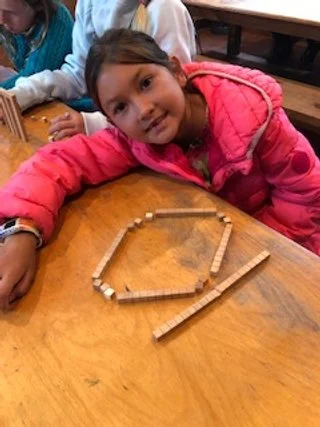
The third and fourth graders have been exploring the Base Ten Blocks after reviewing whole numbers, place values and the concept of grouping, trading or exchanging and regrouping. They worked with the blocks to create numbers and practiced building and counting with and without regrouping to the thousands place. They are practicing identifying number amounts from concrete objects, and writing their numbers in the correct direction in the correct place value. They are exploring algebra with a total amount and missing numbers, using a variety of addition and subtraction strategies to find X, either counting up to meet the total value, or starting with the total value and subtracting the given amount to find the missing amount. Students are advancing to larger numbers and will be implementing multiplication and division strategies using the Base10 Blocks to work out problems in the coming weeks. They are also practicing using relation symbols to compare numbers (<, >, =) when playing “Top It”. I grew up calling this card game war, and the same concept applies for single digit comparisons. The students have been turning over 2 or more cards, making the highest number possible to compare, or adding their card values to compare. Students also enjoyed a fun lesson in time where they experienced what 30 seconds compared to 1 minute felt like as they counted how many steps, claps and times they could say their names happened in these time frames. They enjoyed the wide open field and walked the campus as they engaged in this activity. The data collected will be used for a data analysis lesson, as students compare and analyze the range, mean, median, and more mode of their collected results.
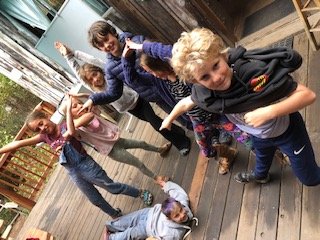
Fourth graders started their Everyday Math lessons. They reviewed concepts and solved problems related to addition, subtraction, skip counting, measurement, money, graphing and finding equivalents for various numbers. They learned endpoints, line segments, lines and rays in a teacher lead lesson, then practiced identifying, naming, and drawing different lines. After discussing the use of these specific components of geometry, building mathematical literacy, students used the beautiful campus to search for and find evidence of the geometry they are learning about. They also had fun using their bodies in a variety of ways to act out these geometric terms. Last week, fourth graders shared what they knew about 2D shapes that consist of line segments and had a beginning lesson on vertices and right angles as they built on prior knowledge. They practiced naming various angles. In the coming weeks they will be continuing geometry lessons and working on angles, triangles, quadrangles, parallelograms, polygons, circles, hexagons and other geometry concepts. This week we are shifting the focus to our Orchard School Harvest Festival, and the kids will be exploring math concepts such as weight, measurement and graphing through APPLES.
Third graders started their Everyday Math lessons. They learned about and practiced using the number grid, considering number sequencing, and patterns such as the columns holding the same number in the ones place as you subtract or add 10. They practiced skip counting by ones, tens, hundreds, and thousands, both forward and backward from a variety of starting points. They used the vocabulary of “increasing and decreasing” by a given number, and looked for patterns on the number grid. They learned why the place value in a given place increases when 10 whole numbers are reached in the previous place value, and solved tricky number-grid puzzles that required careful calculations as they had to subtract and add numbers to fill in the missing puzzle pieces. Third graders also had a lesson on reading analogue clocks to the five minute marks. They practiced telling time by skip-counting by fives for the minute hand after determining which hour the hour hand was after. Students practiced matching digital times to analogue clocks, read and wrote the digital time from a given time on an analogue clock and drew the hands on a clock face to match a given digital time. Students also had the opportunity to practice using some mathematical tools that will be utilized in their studies. These tools included clocks with movable hands, rulers with inches and centimeters, Pattern-Block Templates with common shape stencils and calculators. In the coming weeks, they will be working to analyze and display data, writing equivalent names for given numbers, ordering numbers, practicing finding the difference and totals using a variety of subtraction and addition strategies, finding the value of a given digit in a 4 digit number, measuring in centimeters and inches, counting coins and practicing computation strategies from word problems. This week we are shifting the focus to our Orchard School Harvest Festival, and the kids will be exploring math concepts such as weight and measurement through APPLES.
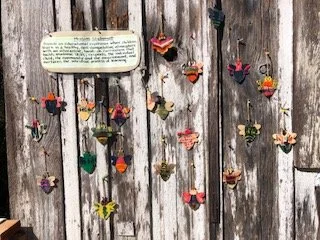
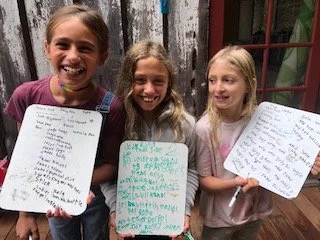
We started the year by brainstorming and discussing topics related to building a safe, meaningful learning community, and how they wanted to be in our classroom environment. We used the idea of “Be Kind” and the students shared their own “Be…” related words for our Math Cabin Bees. Each child colored a wooden bee with their favorite bee idea for the classroom to inspire a loving, thoughtful and helpful community. For example: Be Brave, Be Helpful Be Cooperative, Be Yourself… Students also brainstormed “What is Math?” and they generated a fantastic list of ideas that covered each of the Mathematical Content Strands: number sense, properties, and operations, measurement, geometry and spatial sense, data analysis, statistics, and probability, and algebra and functions. Students conjured ideas about who uses math. They listed many occupations, and each class concluded that everybody uses math. Students examined how they use math in their everyday lives which helped them make new connections to the subject and have a purpose for learning new concepts. They drew themselves as mathematicians or using math in some way for their new binders. They spent time practicing writing numbers, and following dot-to-dot activities to warm up their hands and brains for a new year of mathematics.
The Orchard School “Community Spirit” reminds students to contribute to a learning community by showing respect, acting with kindness, participating in the learning process and taking responsibility for their learning. It is my goal to encourage each and every student in this class to engage everyday with curiosity and inquiry, to use positive communication, to demonstrate care and compassion, and develop cooperative relationships for a productive school year.